Cia Pepa Plana was nominated at the Talía Awards. We attended the performing arts gala, where our show «A cada pas» was nominated for Best Costume Design.

Cia Pepa Plana Nominated for Best Costume Design at the Talía Awards
read more


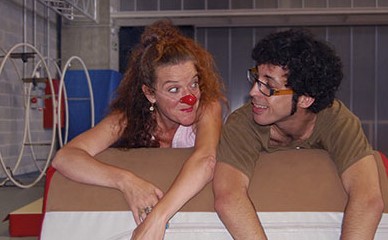

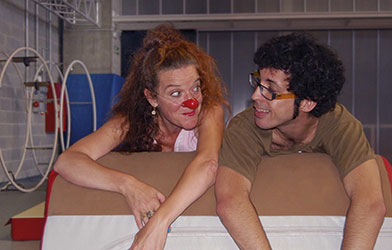
For these summer conversations, the meeting point is La Central del Circ, a fantastic facility located in the Barcelona Forum, overlooking the sea. Circus and clowns might seem like married words, but I soon realize that both had to emigrate from their romantic kingdom a long time ago to explore new scenic territories and discover new audiences. I met Pepa Plana many years ago, when we were both fulfilling a dream of becoming actors and actresses on the Catalan stage, training at the old Institut del Teatre de Barcelona. Meanwhile and at the same time, in Vilanova i la Geltrú, a child of a few years old was growing up eating stages and drinking shows. Now, thanks to ENTREACTE, we make them sit face to face, so that they can get to know each other more personally and we can get to know them better. Same profession but different birth. Same illusions and different projections. Same love and different gaze. They are surely not as “different” as they think, because ultimately they both tread the “same” path of the unique, indomitable and dreamy artist.
Pepa Plana: We could say that we have known each other for a long time, but more through references from others, seeing some of your performances and small encounters, right? The first news I have about you, many years ago, is from your parents (they both laugh). In fact, I have a son a little older than you. (they laugh again) We have seen each other work, we have met at some point, but perhaps we had never stopped to talk in this way… so intimate… (laughter breaks out).
Guillem Albà: Well, I’ve known you forever. This seems strange to me because many people I knew when I was little and had seen around the house, or that my parents had told me about, are now my colleagues in the profession. Now, when I meet people in the profession I think: wow… when I was little I saw you act!
P. P.: We are different generations, but we all come from traditions and teachers who came before us. I have also learned from people I saw when I was young. What happens to me is that now I find spectators who tell me that they saw me when they were little and that makes me think that time has passed a bit (laughs). Yes, my base, my training, is as an actress trained at the Institut del Teatre, and I have to say that at that time I didn’t even know that I wanted to be a clown. In fact, there was nothing or very little about the circus. But now I see that most of the female clowns of my generation, who currently exist all over the world, almost all come from the world of dramatic art. Those who are starting now do have more opportunities to train or practice in a more professional and serious way.
G. A.: How was the transition from actress to clown?
P. P.: Well, by chance. I first put on the clown’s nose just to enrich my acting, I had no intention of dedicating myself to clowning. Taking courses, discovering international clowns who “moved” me and also doing small interventions in “occupied” houses of that time, where there was a lot of cultural activity. After these experiences there was no turning back. It was like an addiction, I thought: “What is happening to me when I am a clown does not happen to me when I am an actress.” In the early nineties there was no circuit here nor was there any female clown alone and for adults. I didn’t care. I had nothing to lose and the adventure began and I did it with my first show: “De P a Pa”. But this is not a monologue! And you… tell me, how did you get here? I know that things are going very well for you and that a few days ago you were given an award in the city of Tàrrega, right?
G. A.: Yes… it’s true and I’m a little embarrassed about this topic. I also started studying theatre at some schools in Barcelona. I was going from here to there. Text theatre, musical, dance. Where I went deeper was with the Lecoq method, which is creative theatre. Because what I did know very clearly from a young age was that I wanted to create my own things. I didn’t want to be “just” an actor. I was attracted to everything: writing, directing… Being aware of everything. Then I took a clown course and later a key person appeared in my career: Jango Edwards. With him, all that disorder fell into place. I understood why I was interested in clowning. I understood the message, the philosophy.

P. P.: (interrupts him) And how do you live your clown?
G. A.: (stops at the question) Ugh… I don’t know how I feel about it. What a question… I’ve been asking… I was very young and daring and one day I told Jango: “I want to do a show.” He said to me: “Okay, come home and I’ll help you.” I was the first one surprised because my parents had told me a lot about him and all his shows. When I got to Jango’s house I called my parents and said: “Dads, Jango is at home and he told me he’s going to direct a show for me.” They were shocked. (laughs) And they said to me: “Son: do it, do it…” And I did it. He helped me a lot. He took me to perform in many places and finally I premiered my first show, very much in Jango’s style. Luckily I did a lot of “bolos” and this allowed me to find my way of doing things more and more. Now I have a new show, but everything has been very busy, almost without me realizing it. There has been an evolution from the first to the second, I have tried to do my homework and look for new things.
P. P.: Don’t take it the wrong way, but I remember that many years ago, when I was just starting to get my nose in, I was told that you start being a good clown at the age of fifty. It’s true that in circus families you start being a clown when you’ve already gone through many other disciplines. Youth is for acrobatics, juggling, trapeze and when you can’t do it with your body anymore, you concentrate all the essence of the circus world in the adult clown. They say that clown makeup, when you’re twenty, doesn’t stick to your face. You need weight, wrinkles, fatigue to be a real clown. It’s the logic of the adult who becomes a child again, after having lived. The clown doesn’t play any character.
G. A.: (Guillem wrinkled his nose here) It’s just that I don’t know if I’m a clown or an actor. If I do circus or if I do theater. I don’t know where to classify myself. At first, when I was a clown, they told me that it wasn’t circus and I started to think that I was doing theater; but the theater people told me that I wasn’t an actor but a clown. In the end, I said: “Well, I act and that’s it.” Now I’ve realized that what interests me is mixing disciplines and I’m clear that being a clown is more of a philosophy, a message, a way of taking things… and that’s it. Finally, it’s a technique.
P. P.: It’s funny that you say that you’re always on the edge of things. I think that’s an indispensable condition for a clown. But my vision of the profession is not so technical, but perhaps more romantic. My clown is always herself and plays at being other people, at experiencing improbable situations, but she always starts from herself.
G. A.: It seems “weird” to me to talk about the clown as if he were a living person, who exists.
P. P.: Let’s see, let’s not get confused, I know how to separate my life from my work. I don’t act like a clown twenty-four hours a day!
G. A.: Well, you’re in luck! Because there are people who don’t know how to do it and they act like clowns twenty-four hours a day (laughs). It’s important to know where the stage begins and ends.
P. P.: My clown is me multiplied by ten thousand. I am not a character. I like to understand that you are not playing anyone, but you are playing yourself. It is me with all the things I think, that I have lived, but revolutionized and shaken. I do not play my clown, I simply let it be. If you play the clown as a character, there would be clowns just like him. If you start from yourself, you will never resemble anyone. I believe that what fascinates the viewer most when they see a clown is their charisma, their unique personality. This also happens with actors, painters, singers… We like and value difference.
G. A.: For me, I think your vision is more that of the classic clown, which comes from another circus tradition. Like, for example, Charles Chaplin or Charlie Rivel, wherever you put them, whatever they lived, they were always them. The same character. I think that a few years ago a new way of presenting the work of the clown has appeared. Of breaking the way of seeing it and that a clown could do more than one character. I think that what Jango Edwards contributed…
P. P.: (cuts him off) Jango also always plays the same character!
G. A.: I don’t agree (laughs). I would say that he has the same style, but he plays different characters. I’m more interested in this way of doing things. Now I play one character, then another. Always starting from the clown base, but with many more possibilities for variety on stage.
P. P.: What is clear is that within the world of clowning there is not a single model. It would only be missing. We can find many types of clowns: the crazy ones, the eccentric ones, the most musical, the ones who talk, the mute ones, the most theatrical, the buffoons… there is a lot of richness. You might, due to the influence of Jango, be more in the category of crazy. (they laugh again).
G. A.: Yes, maybe with the first show yes, I did a more absurd humor, more “destroyer”, more provocative; but now with this second no, I have changed the register. I try, following the same clown language, to go towards a more tender, more romantic, more poetic side. This perhaps exemplifies what my vision of this profession is: always starting from the same base, creating by mixing styles and trying new things.
P. P.: I think what’s happening to you is completely logical given the times you’ve had to live in. In fact, I started clowning late, but my first shows were pure energy and the more I moved the better. Now I’ve been in six shows and I realize every time that I need to move less. That less energy is more. Before, to make people laugh, I would probably do a gesture 300 times and now I’ve discovered that you can make people laugh with just a small movement of your arm. I’ve learned over time that if I move a lot, I get out of focus; although I continue to “emits” the same clowning I did on the first day. I’m going more towards the essence and the controlled breathing of the great masters.
G. A.: (smiling) All that you say is very good, but I’ll find out when I’m fifty. Now it’s not my turn and I wouldn’t know how to do it. The beauty of personal creation is that what you do at any given moment will be the result of what you’re experiencing at any given moment. That’s what interests me most about the world of clowning. And above all, that your work can be seen in many places, not just in Catalonia. That this sometimes hard effort doesn’t go down the drain.
P. P.: Man… now you are living in an era where there is already a tradition of Catalan clown names and whether you like it or not the public already accepts this tradition of theatrical clowns. When I started, perhaps the only one known was Tortell Poltrona. Now when you are in Catalonia you think that all of us who are working on the same line are very different, proposing very varied things and with super beautiful colors. But I have to say that when you go abroad, they do recognize a Catalan stamp on you, which we ourselves do not know how to see. What is clear is that in other European countries there is a very deep-rooted idea that in Barcelona is where the important things happen within the world of clowning. And when I am here I look around me and think… well, how bad the others must be (laughs). Yes, it is true that there is an important associationist tendency within the world of circus, here in our city. And also people like you who make risky proposals and who arrive as innovative ideas in countries that have other ways of understanding the clown.
G. A.: I think there is still a lot of pedagogy to be done here, within the world of performing arts itself. Maybe I don’t know what I am yet. I am a member of the AADPC, but now that they have given me an award in Tàrrega and I am not appearing at the ENTREACTE in the awards section, maybe because I am a clown?
P. P.: You are absolutely right about that. We have circus companies that are enjoying wonderful international tours, but at the time of the awards, there is a lot of ignorance towards circus people. I believe that the discipline of clowning is within the performing arts and to give an example, in the list of the Butaca Awards, the circus does not exist. There is a tailor’s drawer award and we all enter there: puppets, mimes, magicians, clowns. I think that if you do macramé you are also entitled to the award: Other disciplines (we laugh). Or the Max awards, which are the awards of the “Cathedral of the Performing Arts”, the circus does not exist. And we are not four cats that are working. It is not understood why there is no such recognition…

P. P.: We should also take this opportunity to say that in the big theaters in our country, I’m talking about the TNC or the Lliure, spaces that belong to everyone, I think it should be easier to knock on the door and be heard. Sometimes in these spaces, clowns have been relegated to doing children’s matinee performances on Christmas days. And I think that the two of us, like many others who are very good, demand a type of show of this genre, but also for adults, as there are in many other serious programs around the world.
G. A.: Perhaps the key is not so much between clowns and actors, but between productions from the same public theatres or productions conceived by the same companies. It must be very clear that in the world of Catalan entertainment there are two very different spaces: Barcelona and the rest of Catalonia. You don’t get anything from your stay in Barcelona, it’s the showcase and if you do well you get featured in the press and it helps you get “bolos”… they say. It’s doing “bolos” around the territory that you enjoy and can make a little money. The issue is whether you are produced or you produce yourself. I’m interested in being the owner of my creation and that has an economic cost and the risk of not being included in the official programming. I don’t call you Barcelona anymore!
P. P.: But why couldn’t it be that you think of your show and the public theaters of our country program this creation without the need to intervene in the production of the project?
G. A.: Some theaters have gotten used to doing three-month productions. Two months of rehearsals, one month of performances, and then off.
And come spend some money!
P. P.: That’s the big difference. I, and I think you too, when we put on a show, we do it with the intention of carrying it on for the rest of our lives. I keep adding shows and I have them all in my portfolio. Having a repertoire and doing what is asked of you at every moment. That’s also our freedom. The big difference between you and me is perhaps that you are enthusiastic about creating and I have a terrible time every time I have to give birth to a new show. It’s the most distressing process in the world, but I’ve come to think that I’m a masochist because I’ve created a few. I’m only happy when the audience finally enters the room.
G. A.: I am passionate about creation, behind closed doors; I like this process. I enjoy it. There is a technique and a mastery that underpins the path I take to reach the final goal. There is a part where you do need the audience’s reaction… but theater and especially comedy always tends to have a mathematical basis.
P. P.: Uh… I disagree here. What works in a show with actors doesn’t always work in a clown show, because there is an ever-changing element involved, which is the audience. You have to listen a lot. You can’t close yourself off.
G. A.: Obviously! But not everything is left to chance. There has to be a base. That’s how you rehearse. But then, tell me, your functions every day must be different, depending on the audience you have?
P. P.: No… I stick to a structure and I’m very disciplined. But the first few minutes are always tentative, like when you go to dinner at someone’s house you don’t know… you ask permission… there’s a complicity, you want to get along… after a while the formality is lost.
G. A.: I see it very differently. I like the rehearsal room. The solo rehearsal. It doesn’t mean that I don’t think about the audience, but I want to create without conditions. I have a very clear philosophy for this job. Doing things little by little, artisanally and taking things one step at a time. I use the clown to achieve these goals, but I don’t feel tied to him, even though I wouldn’t know how to do anything else.
P. P.: Look, we agree on that! We love this job and it’s proven that you can get there in different ways. (sighs) I like to put my nose in to play the clown….
G. A.: (sighs) Yes, it’s an option, but it’s not necessary either…
I leave them talking… there is passion and tenderness in their arguments. It has been a very interesting conversation. Two generations face to face. Two ways of understanding this very personal art of making people laugh. Finally I come to the conclusion that every clown is the fruit of the time they have to live in. With or without a nose: please! Let the clowns pass.
By Martí Peraferrer – Photographs: Irene Roé
Cia Pepa Plana was nominated at the Talía Awards. We attended the performing arts gala, where our show «A cada pas» was nominated for Best Costume Design.

This June we are bringing A CADA PAS to Vinaròs, as part of the Alè Vinaròsenc event.

At the 2026 edition of the Performing Arts Critics’ Awards, Pepa Plana was honored with the Maria Josep Ragué Award
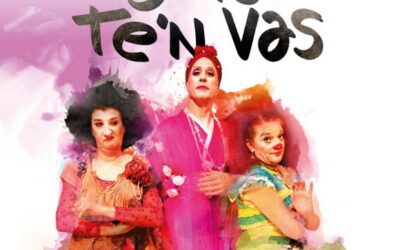
We are very happy to announce that Si tu te’n vas is returning to Barcelona. This time at the Teatre de Sarrià. Next February 28th and March 1st and 2nd.

On May 16, we premiered our new show A CADA PAS. It was at the Fortuny Theater in Reus, as part of the Trapezi 2025 Fair program.

This April we start again in the Canary Islands with Si tu te’n vas, specifically in Lanzarote, at the TEATRO VÍCTOR FERNÁNDEZ GOPAR “EL SALINERO”.